
Independent Living vs Assisted Living in Peoria, AZ
Choosing between independent living and assisted living is not simply a question of age. The better question is how much help a person needs during an ordinary day, and how much freedom, privacy and social connection they want in their next home. Both options can remove the work of maintaining a house, but they provide different levels of support.
For families comparing senior living in Peoria, it helps to look beyond labels. Think about meals, housekeeping, transportation, personal care, safety and the amount of daily assistance that would make life easier without taking away independence.
What Independent Living Is Designed to Provide
Independent living is generally a good fit for someone who can manage personal care and everyday decisions without assistance. Residents have a private apartment or casita while leaving much of the property maintenance and household work to the community.
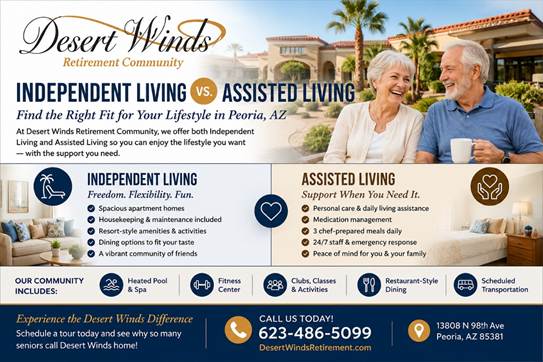
At Desert Winds, choices include studio, one bedroom and two bedroom apartments, along with casitas. Depending on the residence, features may include a full kitchen, private patio or balcony, attached garage and laundry facilities. Community amenities include dining, scheduled transportation, activities, a pool, fitness room, library and billiard room.
This may suit someone who remains active but no longer wants to arrange repairs, maintain a yard or drive for every appointment.
When Assisted Living May Be the Better Fit
Assisted living combines housing and community life with added personal support. It may be appropriate when bathing, dressing, grooming, meal preparation or household tasks have become difficult or tiring.
Desert Winds completes an assessment before move in so staff can prepare an individual care plan. Residents also receive three meals, snacks, housekeeping, laundry services, scheduled transportation, an emergency call system and access to staff around the clock.
Needing help does not mean giving up control. Assisted living should provide support where it is useful while allowing residents to keep doing what they can manage comfortably.
Look at Daily Tasks, Not Just a Diagnosis
A diagnosis does not always show how someone functions at home. Two people with the same condition may need different support. A practical comparison should begin with a normal week.
Can the person shower and dress without difficulty? Are meals prepared regularly? Is the home reasonably clean? Are appointments missed because transportation is a problem? Has loneliness become a concern? Is a spouse or adult child doing more caregiving than they can sustain?
Honest answers usually clarify the choice.
Think About Present and Future Needs
Choose for the life a person has now, but discuss what could change. Ask what happens if mobility declines, personal care becomes necessary or memory problems affect routines. Find out how care assessments are updated and what additional services may cost.
Also consider whether the apartment, common areas and transportation will remain practical if walking becomes harder. Planning ahead can prevent a rushed decision after an illness or hospital stay.
Compare Lifestyle, Privacy and Community
Support matters, but so does the feel of the community. Some residents want a full activity calendar and restaurant style dining. Others value a quiet apartment, familiar routines and the choice to participate only when they wish.
During a visit, notice whether residents appear comfortable with staff and one another. Ask to see the activity calendar, dining room and available floor plans. The right setting should feel like a home, not merely a list of services.
Explore Your Options at Desert Winds
Desert Winds Retirement Community offers independent living, assisted living and memory care near the Peoria and Sun City border. To discuss the level of support that best matches your needs or arrange a personal tour, call 623-343-5830 today.
References
National Institute on Aging: Assisted Living and Nursing Homes
Arizona Department of Health Services: Residential Facilities Licensing
Centers for Disease Control and Prevention: Social Connection